
What Is Auditory Processing Disorder?
Auditory Processing Disorder (APD) is a brain-based condition that affects how the brain interprets and organizes sound. Individuals with APD usually have normal hearing ability, but their brain struggles to process auditory information—especially in noisy environments, group settings, or when instructions are fast or complex.
They may hear sounds clearly but still find it difficult to understand what is being said. This is not a problem with the ears—it’s a problem with how the brain processes sound. That’s why APD is often referred to as a “hidden” disorder. The hearing is intact. The processing is not.
How the Brain Processes Sound
Hearing begins in the ears, but it’s the brain that must decode, filter, sequence, and assign meaning to what we hear. This is known as auditory processing.
In people with APD, sound information reaches the brain but is not processed efficiently. Words may be distorted, misordered, or partially lost. In everyday life, this causes breakdowns in understanding, listening fatigue, and delayed responses to spoken language.


How APD Manifests in Real Life
Many individuals with APD perform well in quiet, one-on-one conversations but begin to struggle in more complex environments like classrooms, meetings, or group discussions. They may:
These difficulties often lead to confusion, frustration, and misinterpretation of the root problem.
Why APD Is Often Misdiagnosed
APD is frequently misdiagnosed as ADHD, speech delay, or a general learning disorder. A key reason is how most evaluations are conducted.
Most neuropsychological and school-based assessments are done in quiet, one-on-one settings—the very situation where individuals with APD tend to perform best. These controlled conditions do not reflect real-life environments where APD symptoms are triggered: noisy classrooms, rapid speech, or multitalker situations.
Without simulating real-world listening challenges, traditional testing often misses auditory processing deficits. As a result, secondary symptoms like distractibility or incomplete work may be incorrectly attributed to attention or behavioral disorders.


APD and Reading Difficulties: The Link with Dyslexia
Dyslexia is Treatable
Although reading may seem like a visual activity, it relies on auditory processing. When we read, the brain must convert written letters into sounds and link those sounds to meaning—a task that heavily involves the auditory cortex. This is even true for people who cannot see and use braille to read.
For individuals with APD, this decoding process is often impaired. They may struggle with phonics, confuse similar-sounding words, or read slowly and laboriously.
Comprehension may also suffer, not because of poor reasoning, but because the brain cannot efficiently process the incoming information.
Gifted and intelligent students may compensate by relying on logic or visual cues, but as reading volume increases with grade level, this strategy eventually fails. These students often experience frustration, fatigue, and declining confidence as academic demands surpass their brain’s ability to process text through sound.
73% Of our clients see one grade or more improvements in their reading comprehension in less than 60 days.
Some Symptoms of Auditory Processing Disorder
Symptoms vary but often involve a combination of difficulties with listening, learning, attention, and communication. These can include:
Why Speech Therapy Alone Doesn’t Work for APD
Many students with APD are placed in speech therapy early in life due to language delays. While speech therapy can improve articulation and expressive language, it does not target how the brain receives and processes sound.
Speech-language therapy addresses output—how the child speaks. APD is a disorder of input—how the brain hears and makes sense of sound.
As a result, even after years of speech therapy, many individuals with APD continue to struggle with comprehension, classroom listening, and reading. Without addressing the brain’s auditory decoding system, progress remains limited.


Brain Wellness Revolutionary Treatment of Auditory Processing Disorder:
Our Brain-Based Treatment Approach
At Brain Wellness Center, we identify and treat APD using objective, scientific tools that target the neurological source of the problem. Our approach is personalized, drug-free, and grounded in decades of brain research.
Functional qEEG Brain Mapping
We begin with a functional brain scan using quantitative EEG (qEEG) to identify how the brain processes auditory information. This non-invasive assessment allows us to:
A Proprietary Program Unmatched in Its Precision, Effectiveness, and Convenience
Audio Processing Training™ (APT): A Breakthrough in Auditory Processing Disorder
Auditory Processing Training™ (APT™) is a proprietary, neuroscience-based intervention developed exclusively by Brain Wellness Center under the direction of Dr. Hashemian. APT™ is designed to restore and enhance the brain’s ability to accurately receive, filter, and interpret sound—core functions that are impaired in conditions such as Central Auditory Processing Disorder (CAPD), ADHD, autism, sensory processing difficulties, and language delays.
What makes APT™ truly unique is that it is not a replication or variation of existing programs—it is a wholly original system, refined over 35 years of clinical experience and built upon training with both Dr. Alfred Tomatis and Dr. Guy Berard, the founders of auditory integration therapy.
While Tomatis and Berard laid the foundation, Brain Wellness Center has taken the science significantly further by engineering a modern, high-impact program that:

Each client receives a fully configured APT™ system, including:
This at-home model ensures that the therapy evolves with the client’s progress, making it as dynamic as it is effective.
94% Of our clients report positive improvements and (73%) of our patients double their auditory processing skills in less than 90 days.( based on objective, pre- and post-treatment measures.)
APT™ is not a franchise or repackaged system. It is a proprietary, results-driven program available only at Brain Wellness Center—representing the most advanced form of auditory training available today.
These are some of the improvements observed by the parents and patients within 30-90 days after starting with us:


The Science Behind Audio Processing Training™
Frequency Filtering and Gating
Bone Conduction for Direct Auditory Stimulation
Sound is delivered through both air conduction (via headphones) and bone conduction (via a skull-mounted transducer)
Key Benefits:
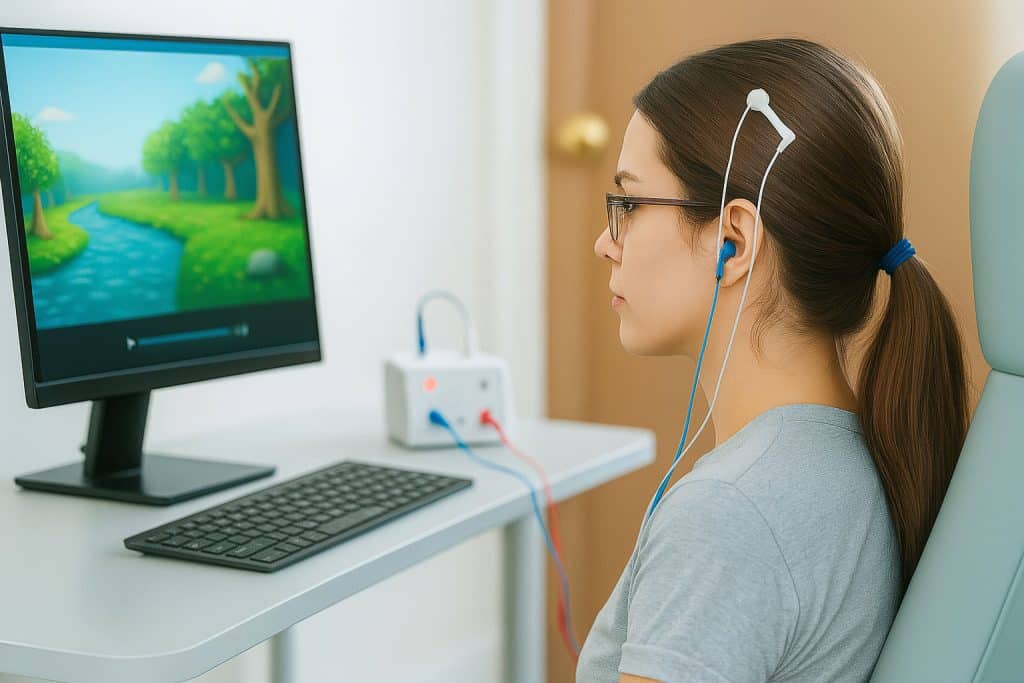

qpTMS™ – Quantum Phased Targeted Magnetic Stimulation
Although qpTMS™ uses phase-specific magnetic stimulation to activate underperforming auditory and language-processing areas of the brain, it is not usually the first line of treatment for these issues. At Brain Wellness Center, we typically begin with Auditory Processing Training (APT), which directly strengthens the brain’s ability to decode sound, improve attention to auditory input, and enhance language clarity. APT addresses the functional processing deficits at the core of many listening and communication challenges. When needed, qpTMS™ may be added later to reinforce network connectivity and accelerate results—especially in more resistant or neurologically complex cases.
Frequently Asked Questions
Audio Processing Training™ (APT)™ helps with auditory processing disorder ( Central auditory processing disorder, CAPD), ADHD, Dyslexia, sensory processing, autism spectrum disorders, learning disabilities, emotional regulation, gross motor function, balance and coordination, and various sensory processing issues.
Brain Wellness Center Personalized Audio Processing Training™ (APT)™ is an innovative treatment for auditory processing disorder that enhances the brain’s ability to process sound. This advanced treatment combines cutting-edge techniques of modern science with the work inspired by the works of Dr. Alfred Tomatis, creator of the Tomatis Method ®, and the work of Dr. Guy Berard, creator of Auditory Training.
Audio Processing Training™ (APT)™ delivers therapeutic sound through specialized bone-conduction headphones. The therapy is seamlessly integrated into music, similar to medicine in flavored syrup. This innovative approach actively stimulates and reorganizes neural pathways, effectively addressing auditory processing disorder symptoms.
Audio Processing Training™ (APT) is completely safe and highly effective. Audio Processing Training™ (APT)™ is non-invasive and without side effects. Our professional team ensures gentle yet effective therapy with no adverse effects.
Audio Processing Training™ (APT)™ activities typically require 30-90 hours of listening, depending on the assessment results of Auditory Processing evaluation results. We recommend 30-minute sessions twice daily (3-hour gap for children under 11) or single 60-minute sessions for older individuals daily.
The musical selection isn’t crucial to Audio Processing Training™ (APT)™. Like medicine in flavored syrup, the therapeutic benefits are embedded within the music, focusing on effective treatment rather than musical preference.
Our specialized treatment for auditory processing disorder uses filtered and modulated music to deliver precise therapeutic sound, stimulating the auditory system and reorganizing neural pathways for improved processing abilities.
Yes, Audio Processing Training™ (APT)™ is often used to improve speech and language skills by enhancing auditory processing and phonological awareness. These improvements enable better sound detection and interpretation, which is essential for effective communication and language development.
Yes, our specialized auditory processing disorder treatment significantly improves reading skills by enhancing auditory processing abilities and phonological awareness. These fundamental skills are crucial for decoding written language, making reading more fluent and comprehension stronger.
Audio Processing Training™ (APT)™ helps desensitize the auditory system through controlled exposure to specific frequencies. This systematic approach reduces sound sensitivity and enhances focus on relevant auditory information, which is particularly beneficial for those with central auditory processing disorder.
Yes, Audio Processing Training™ (APT)™ supports emotional regulation by improving sensory integration and balancing the auditory system. This balanced approach is especially helpful for children with auditory processing disorder and ADHD who struggle with emotional control.
Our comprehensive auditory processing disorder treatment enhances integration between auditory and other sensory systems, including vision and touch. This improved integration leads to better overall sensory processing and daily functioning.
Yes, our treatment for auditory processing disorder in adults and children enhances motor coordination by strengthening the connection between auditory input and motor control systems, resulting in smoother, more coordinated movements.
While results vary individually, many clients notice improvements within weeks of consistent auditory processing disorder treatment. Maximum benefits typically emerge after completing the recommended 30-90 day program.
Absolutely! Our auditory processing disorder treatments are effective for all ages. Each program is customized to address specific symptoms of auditory processing disorder in both children and adults.
Yes, our treatment includes specialized bone conduction headphones and a device containing your customized program, all provided by the Brain Wellness Center.
A professional consultation at our center helps determine the most appropriate auditory processing disorder treatment. We assess individual needs and develop a personalized training plan based on specific symptoms and goals.
Our innovative approach combines therapeutic sound with advanced bone conduction technology, delivering personalized treatment for auditory processing disorder. The therapy is seamlessly integrated into music, ensuring effectiveness and ease of use.
Yes, our auditory processing disorder treatment Berard method-inspired programs are designed for convenient home use with provided equipment and a structured listening schedule, making it accessible for all ages.
No, our advanced auditory processing disorder treatment is distinct from the Tomatis Method. It represents a sophisticated evolution, combining the best elements of both Tomatis and Berard approaches for enhanced treatment outcomes. Unlike traditional methods, our program provides individualized treatment for each ear, recognizing that auditory processing challenges can differ between ears. The integration of precise audiometric testing ensures superior accuracy in treatment delivery.
While both target auditory processing disorder symptoms, our treatment differs significantly from conventional AIT. Our approach employs cutting-edge bone conduction technology and therapeutically modified music, customized for each ear’s specific needs. The incorporation of detailed audiometric testing allows us to precisely identify and address frequency sensitivities, making it a more targeted treatment for auditory processing disorder.
No, our program is a unique, proprietary treatment for auditory processing disorder in adults and children, developed by the Brain Wellness Center. It innovatively combines proven methodologies while adding advanced features for optimal results.
How is audiometric testing in Brain Wellness Center Personalized Audio Processing Training™ (APT)™ different?
Unlike conventional methods that use standard audiometers with limited capabilities (measuring in 5 or 10-decibel steps at basic frequencies like 500, 750, 1000, 1500, 2000, 4000, 8000 Hz), our central auditory processing disorder treatment incorporates sophisticated audiometric testing directly within the system, significantly enhancing accuracy and reliability.
Our advanced system enables testing at precise 1-decibel increments across an extensive frequency range: 250, 500, 750, 1000, 1500, 2000, 3000, 4000, 5000, 6000, and 8000 Hz. This exceptional precision allows us to identify exact frequencies where individuals experience hypersensitivity, making our auditory processing disorder treatment activities more effective. The seamless integration of testing eliminates manual data entry required in traditional systems, improving efficiency and reducing error potential. For those searching for “auditory processing disorder treatment near me,” our comprehensive approach offers unparalleled precision and effectiveness in addressing auditory processing challenges.
Currently, insurance plans do not cover our specialized auditory processing disorder treatment, and Brain Wellness Center does not accept insurance for these services due to coverage limitations.
Our comprehensive treatment for auditory processing disorder is not covered under standard insurance plans, and therefore, we cannot process insurance claims
Yes, we gladly accept Health Savings Accounts (HSA) for our central auditory processing disorder treatment services, as they qualify as legitimate medical expenses. We also welcom
No. Insurance does not cover TMS for APT. Coverage is limited to treatment for Major Depressive Disorder. APT is considered an experimental or non-covered service and would require self-pay.
Blue Shield does not provide coverage or reimbursement for Auditory Processing Training. However, it does cover TMS treatment for depression at the Brain Wellness Center.
Blue Cross does not provide coverage or reimbursement for Auditory Processing Training. However, it does cover TMS treatment for depression at the Brain Wellness Center.
Anthem does not provide coverage or reimbursement for Auditory Processing Training. However, it does cover TMS treatment for depression at the Brain Wellness Center.
Cigna does not provide coverage or reimbursement for Auditory Processing Training. However, it does cover TMS treatment for depression at the Brain Wellness Center.
Aetna does not provide coverage or reimbursement for Auditory Processing Training. However, it does cover TMS treatment for depression at the Brain Wellness Center.
Magellan does not provide coverage or reimbursement for Auditory Processing Training. However, it does cover TMS treatment for depression at the Brain Wellness Center.
Medicare does not provide coverage or reimbursement for Auditory Processing Training. However, it does cover TMS treatment for depression at the Brain Wellness Center.
Value Options does not provide coverage or reimbursement for Auditory Processing Training. However, it does cover TMS treatment for depression at the Brain Wellness Center.
TriWest does not provide coverage or reimbursement for Auditory Processing Training. However, it does cover TMS treatment for depression at the Brain Wellness Center.
TriCare does not provide coverage or reimbursement for Auditory Processing Training. However, it does cover TMS treatment for depression at the Brain Wellness Center.
MHN does not provide coverage or reimbursement for Auditory Processing Training. However, it does cover TMS treatment for depression at the Brain Wellness Center.
Covered California does not provide coverage or reimbursement for Auditory Processing Training. However, it does cover TMS treatment for depression at the Brain Wellness Center.
Health Net does not provide coverage or reimbursement for Auditory Processing Training. However, it does cover TMS treatment for depression at the Brain Wellness Center.
Beacon does not provide coverage or reimbursement for Auditory Processing Training. However, it does cover TMS treatment for depression at the Brain Wellness Center.
Quantum does not provide coverage or reimbursement for Auditory Processing Training. However, it does cover TMS treatment for depression at the Brain Wellness Center.
Evernorth does not provide coverage or reimbursement for Auditory Processing Training. However, it does cover TMS treatment for depression at the Brain Wellness Center.
Carelon does not provide coverage or reimbursement for Auditory Processing Training. However, it does cover TMS treatment for depression at the Brain Wellness Center.
Medi-Cal does not provide coverage or reimbursement for Auditory Processing Training. However, it does cover TMS treatment for depression at the Brain Wellness Center.
County Health Plans do not provide coverage or reimbursement for Auditory Processing Training. However, it does cover TMS treatment for depression at the Brain Wellness Center.
When approved for depression, insurance typically covers one session per day, five days per week, for a total of 36 sessions over about 7.5 weeks. For APT-focused care, self-pay or hybrid options are available.
Yes. Brain Wellness Center offers a free initial consultation. If you also have symptoms of depression, we’ll assess your history to determine if you qualify for insurance-covered TMS under that diagnosis. Otherwise, APT is self-pay.
No. Insurance does not cover APT or TMS for APT. Our team handles all insurance verification to determine if coverage is possible under a co-occurring depression diagnosis.
Since TMS is only FDA-approved for Major Depressive Disorder, patients with other concerns (like APT) may still qualify if they also meet clinical criteria for depression. We ensure all diagnoses reflect your true clinical profile.
No referral is required. Brain Wellness Center performs its own clinical assessment to determine if TMS or APT is appropriate. Insurance billing is only pursued for qualifying depression treatment.
No. Insurance does not cover TMS for APT in children or adults. TMS is only reimbursed for depression, generally starting at age 15.
No. TMS is not FDA-approved or covered by insurance for APT. If depression is also present, coverage may be available under that diagnosis.
MDD is a clinical diagnosis based on symptoms like persistent sadness, loss of interest, fatigue, and poor sleep. Insurance requires a qualifying score—typically 20 or higher on the PHQ-9 scale—to authorize TMS. This depression screening form is available on the Brain Wellness Center website.